This article on Scotopic vs. Photopic vision is the first in a series of three that will look into how we perceive and analyze the light that we see. Human perception of any lighted environment is influenced by both Scotopic and Photopic vision. However, only Photopic vision is considered relevant to light metering.
Photopic Properties
- Known as light or daylight vision (“cones”)
- Peak sensitivity towards red (550 nm)
- Higher sensitivity as the light is brighter
- Basis for modern photometry (light metering)
Scotopic Properties
- Known as dark or night vision (“rods”)
- Peak sensitivity towards blue (500 nm)
- Higher sensitivity and speed in different spectral range
- High color temperature lamps 5000K – 7000K
While rods are known to be present with night vision, they are also active in bright light and contribute to the perception of brightness. Scotopics contribute to improved acuity although Scotopics true effects in this regard are not well defined. What is well-known is that higher Scotopic light sources are able to provide equivalent brightness with lower energy usage. This is how LED, despite using far less energy, has been able to match or better light output from the light sources that have preceded it, such as metal halides and halogens.
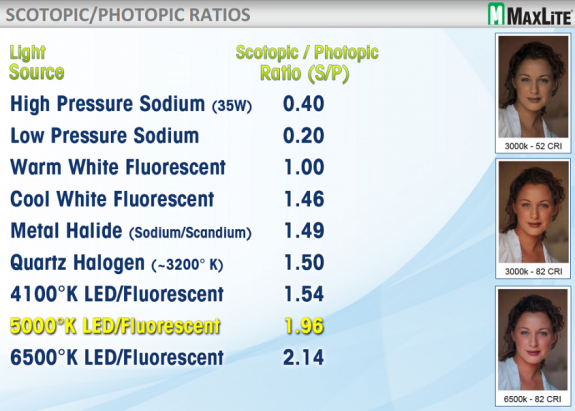
Below are some examples of how different light sources fare in regards to their Scotopic/Photopic Ratio (S/P).
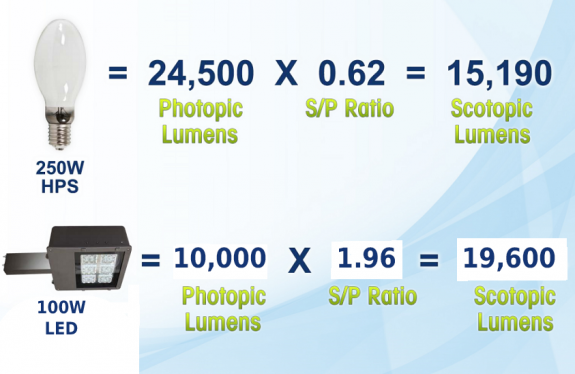
Here is a good statistical comparison between High Pressure Sodium (HPS) vs. LED. In particular it shows how despite HPS’ high energy usage and superior photopic lumens, the true light levels they deliver fail to match up to LED due to an inferior S/P Ratio.